Solar Panel Cleaning guide
How to Prepare for Your Solar Panel Cleaning Call
How to Prepare for Your Solar Panel Cleaning Call
Preparing takes about ten minutes and makes a real difference to how smoothly the job goes. Tidy access, a clear roof path, and a few answered questions upfront mean the technician spends time cleaning rather than problem-solving, and you get a more accurate quote before anyone shows up.
Here is what to sort out before we arrive.
What Information to Have Ready When You Book
The more you can tell us upfront, the less guesswork goes into your quote. Solar panel cleaning prices in Brisbane typically range from around $250 to $600 depending on system size, panel condition, and roof access. Getting that number right the first time saves a follow-up conversation.
Have these details ready when you call or fill in the form:
- Number of panels. Check your original installation paperwork or your inverter app. A standard residential system around Auchenflower and Toowong tends to be 6.6 kW, which usually means 16 to 20 panels. Yours might be smaller or larger.
- Approximate roof pitch and height. A single-storey Queenslander in Red Hill is a different job from a two-storey rendered home in Bardon. Steeper roofs and greater heights affect safety requirements and time.
- Last time the panels were cleaned. If it has been more than 12 months, or if you honestly cannot remember, say so. That flags a possible heavy build-up clean rather than a standard wash, and the pricing reflects that.
- Any known issues. Cracked glass, loose frames, pigeons nesting under the array. Mention it early rather than letting the technician discover it mid-job.
You do not need to pull out your original installation contract or dig up the installer's name. That information is useful for a pre-sale inspection report, but not for a routine clean.
Check Your Roof and Ground Access
This is the step most people skip, and it is the one that causes delays on the day.
Walk around the outside of your home before the booking. Look at how a person would actually get onto your roof. In older Inner West Brisbane suburbs like Paddington, Ashgrove, and Bardon, it is common to have steep block falls, narrow side gates, or timber Queenslander stumps that make ladder placement awkward. None of these are dealbreakers, but knowing about them in advance helps.
Specifically, check:
- Gate locks and clearances. If we need to bring equipment through a side gate, make sure the gate is unlocked and wide enough. A standard extension ladder needs roughly 600 mm of clearance to pass through comfortably.
- Pets. Secure dogs before the job starts. This sounds obvious but gets forgotten regularly.
- Parked cars. If a vehicle is under or near the roofline where we are working, move it. Deionised water runoff is harmless, but dislodged grit is not.
- Overhanging branches. Jacaranda trees are everywhere in this part of Brisbane, and their branches can obstruct roof access or drop debris straight after a clean. If a branch is directly over your array, mention it.
If you are in a unit or townhouse complex, check with your body corporate before booking. In most cases, individual lot owners can arrange cleaning of their own panels, but some complexes want written notification first.
Understand What the Clean Does and Does Not Include
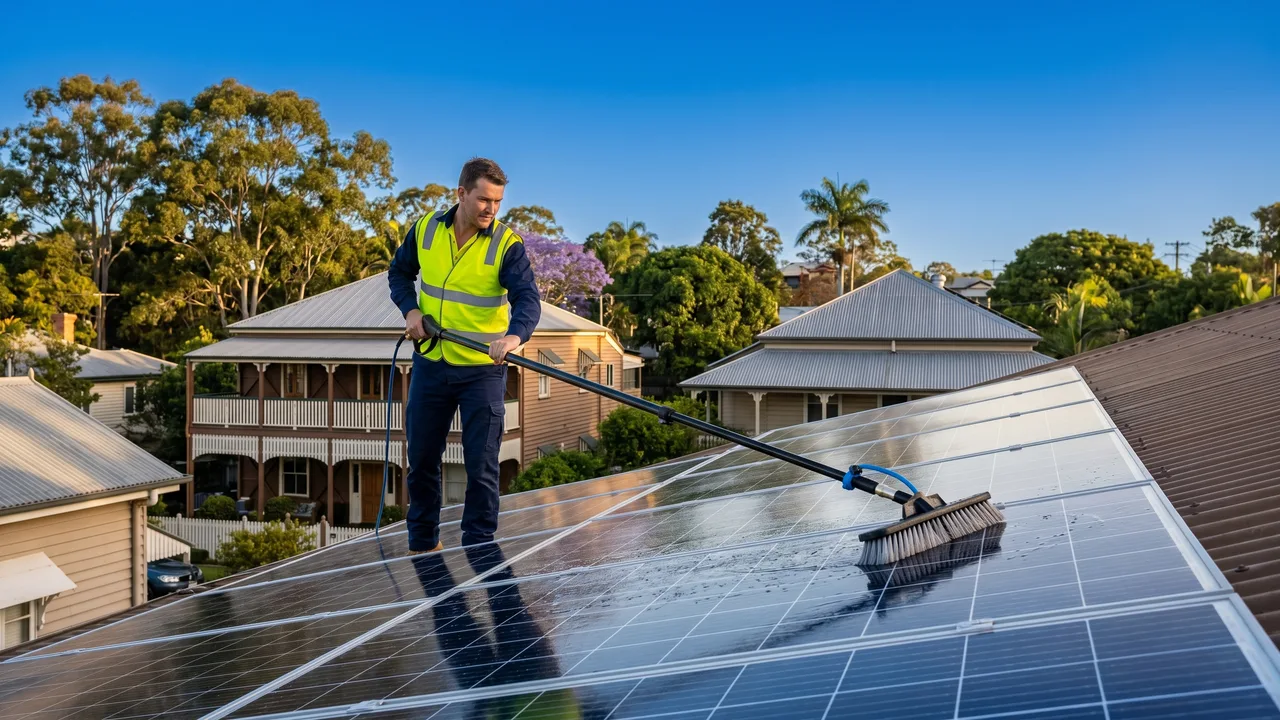
A standard solar panel clean uses a soft-bristle brush and deionised (DI) water. The deionised part matters: tap water leaves mineral deposits as it dries, which is exactly the kind of film you are trying to remove. DI water rinses clean and leaves no residue.
What a standard clean removes: dust accumulation, bird droppings, atmospheric grime, and pollen. Brisbane's Inner West copped heavy jacaranda pollen each spring, and it settles into panel frames and between glass surfaces. A single clean typically restores meaningful output, though the exact percentage improvement varies by how dirty the panels were to begin with.
What a standard clean does not include:
- Inverter inspection or electrical checks. We look at the physical panels, not the wiring.
- Gutter cleaning. If your gutters are full of debris that is washing onto your panels, that is a separate job.
- Bird mesh installation. That is quoted and booked separately. If you are finding feathers and nesting material under your panels, ask about mesh when you call so we can schedule it alongside or after the clean.
A heavy build-up clean, for panels that have not been touched in over a year, takes longer and costs more. Baked-on grime from Brisbane summers sometimes requires additional passes and a longer dwell time. It is still the same soft-brush method, not pressure washing. Pressure washing can force water into frame seals and void some panel warranties, so we do not use it.
Decide Whether You Want an Inspection at the Same Time
A cleaning visit is a natural opportunity to have someone look closely at your panels. Most faults are visible during a clean: microcracks in the glass, delamination (where the protective layer lifts from the cell), discolouration, frame corrosion, or animal damage beneath the array.
For most households, a quick visual check during a standard clean is enough. The technician will flag anything obvious.
If you are planning to sell the property, that is a different situation. A formal pre-sale solar inspection report documents system condition independently, which is useful for disclosures and can help justify price. Our pre-sale inspection is a separate service with its own report format, so mention it when you book if that is relevant.
If you are simply curious about system performance, your inverter's monitoring app is usually the better starting point. A clean that restores normal output will show up in the data within a day or two of good sun.
On the Day: Three Small Things That Help
You do not need to be home for the external portion of the clean, but someone should be contactable by phone. If the technician arrives and finds an unexpected issue (an unusually steep section of roof, a panel with visible damage, nesting that was not mentioned), you want to be reachable to make a quick call on how to proceed.
Three things that genuinely help on the day:
- Turn the solar system off at the isolator before we start. This is a safety step. Your installer's manual explains where the DC isolator is, typically on the roof near the panels and at the inverter. We can talk you through it if needed.
- Clear the area below the work zone. Pot plants, outdoor furniture, kids' toys on the deck or patio. The job involves water and the occasional dislodged bit of debris, and shifting things takes time.
- Have a hose tap accessible. We bring our own DI water supply, but access to a standard tap nearby is useful as a backup.
A Realistic Expectation on Cost and Frequency
For a typical residential system in Auchenflower, Toowong, or the surrounding suburbs, a standard clean costs between $250 and $400. Larger systems, steep roofs, or heavy build-up push that toward $500 to $600. These are honest ballpark figures, not locked prices. Every quote we give is based on the actual job details.
On frequency: twice a year is a reasonable target for most Inner West Brisbane homes. Spring cleans before peak solar months make sense, and a post-summer clean (February or March) clears the dust and pollen that accumulate over the hottest period. If you have significant tree cover, especially gum trees or jacarandas directly above the array, quarterly might be worth considering.
An annual maintenance plan locks in twice-yearly cleans at a fixed price, which suits people who would rather not think about it. Whether that is worth it compared to booking one-off visits depends on how much you value not having to remember.
Before You Call
You do not need to have everything perfectly sorted. Most bookings take three or four minutes and the main thing we need is your address, a rough panel count, and an honest answer about when they were last cleaned. Everything else we can work through together.
If you are in Auchenflower, Paddington, Bardon, Toowong, Milton, Rosalie, Red Hill, Ashgrove, or The Gap, we cover your area and can usually give you a same-week quote. Give us a call when it suits you.
Quick answers