Solar Panel Cleaning guide
Why bird droppings damage solar panels (and what to do about it)
Why Bird Droppings Damage Solar Panels (And What to Do About It)
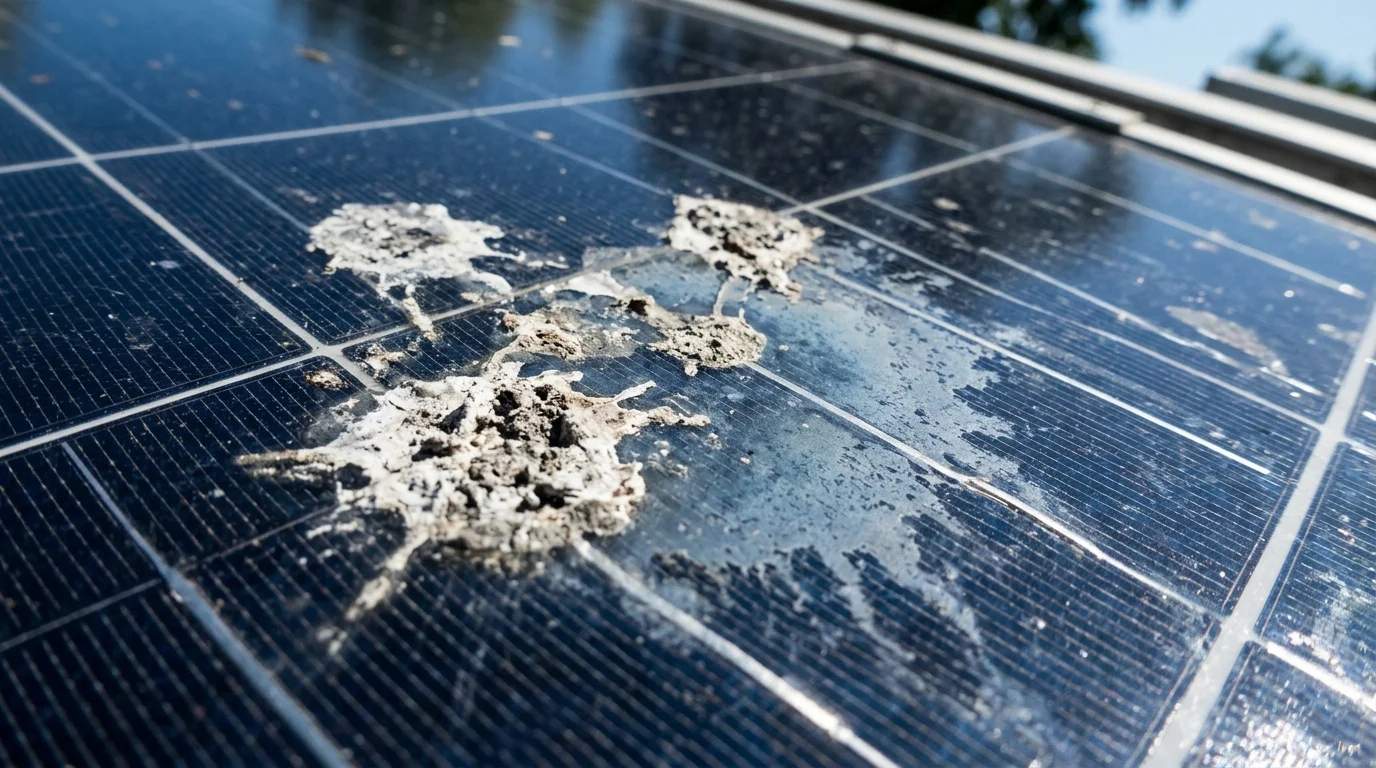
Bird droppings damage solar panels in two ways: they block sunlight from reaching the cells, and the uric acid in the waste chemically etches the glass surface over time. Even a small smear can have a disproportionate effect on output, and if you leave it long enough, the damage becomes permanent.
How Bird Droppings Actually Reduce Power Output
Solar panels generate electricity when photovoltaic (PV) cells absorb sunlight. Block that light, even partially, and output drops. The tricky part with bird droppings is something called partial shading, and it behaves differently from uniform dust.
Most residential solar systems use panels wired in strings, where cells within each panel are also connected in a series circuit. When one section of a panel is shaded, it can drag down the performance of every cell connected to it in that string. A single dropping the size of a 50-cent coin can, in some panel configurations, reduce the output of that entire panel by 20 to 40 per cent. Engineers call the heavily shaded cell a "hot spot" because it starts dissipating energy as heat rather than passing it along as useful electricity.
Uniform dust and pollen spread the shade evenly, so the impact is more predictable and the loss is roughly proportional to coverage. Droppings are concentrated, so the loss is disproportionate. That is why even one messy pigeon can cost you more output than a week of jacaranda pollen settling across the whole surface.
The Chemical Problem: Uric Acid and Glass Etching
Birds excrete uric acid rather than liquid urea (as mammals do). Uric acid is a paste-like substance that bonds to glass quickly and becomes harder to remove the longer it sits. In Brisbane's climate, the combination of heat and UV accelerates this bonding process considerably.
During a typical Inner West Brisbane summer, panel surface temperatures regularly reach 60 to 70 degrees Celsius by mid-morning. At those temperatures, a fresh dropping can partially bake onto the glass within a day or two. After two to three weeks of sun exposure, what started as a soft smear becomes a mineralised deposit that resists a simple hose-down.
If that deposit is left for several months, the uric acid begins to micro-etch the anti-reflective coating on the glass. This coating is what allows the glass to transmit maximum light into the PV cells. Once it degrades, the damage is not reversible with cleaning. The panel's long-term performance is permanently reduced, even after the visible stain is gone.
This is not hypothetical. Panel manufacturers consistently list bird dropping residue as a warranty exclusion for glass coating damage, precisely because the chemical interaction is well established.
Why Brisbane's Inner West Has a Particular Problem
Auchenflower, Bardon, Red Hill, Ashgrove, and the surrounding suburbs sit within a genuinely urban-forest environment. Mature fig trees, poinciana, jacaranda, and camphor laurel are everywhere. These trees are exactly where IBises, pigeons, and Indian mynas roost overnight and shelter during the day.
Rooftop solar panels are attractive to pigeons for a specific reason: the gap between the panel frame and the roof deck is warm, sheltered from rain, and invisible from the street. Once a pair of pigeons establishes a nest under your panels, droppings accumulate both beneath the array and across the panel faces where birds perch on the frame edges. A nesting colony can deposit far more waste than passing birds, and the problem compounds with each season if the nests are not removed.
If your home has older tin or terracotta roofing (common in the Queenslander homes throughout Paddington, Toowong, and Ashgrove), the roof pitch and overhang profile can also create wind eddies that concentrate airborne debris directly onto panels. This is one reason panels in this area typically need more frequent attention than the manufacturer's general maintenance guidelines suggest.
Cleaning Options: What Works, What Doesn't, and What Costs More Long-Term
Hosing from the ground is the first thing most people try. For fresh dust and pollen, it sometimes works. For bird droppings, it rarely removes the baked residue and can smear the uric acid further across the surface. Tap water also leaves mineral deposits when it evaporates on hot glass, which creates an additional layer of light-blocking film.
Wiping with a household cloth or squeegee risks micro-scratching the glass if there is any grit present, which is almost always the case in Brisbane's environment. Scratched glass diffuses incoming light rather than transmitting it cleanly.
Professional soft-brush cleaning with deionised water is the standard recommended approach. Deionised (DI) water has had its minerals removed, so it rinses away residue without leaving deposits. The soft brush lifts droppings without abrasion. For panels that have not been cleaned in twelve or more months, a heavier treatment may be needed to break down baked-on material before the DI rinse.
Typical costs for a standard residential clean in this area run from around $250 to $400 for most systems, with heavier build-up work towards $500 to $600 depending on panel count and access. That is a meaningful expense, but set it against the output loss: a system losing 15 to 25 per cent of production due to soiling, over six to twelve months, is likely costing you more in lost feed-in tariff or avoided grid import than the clean does.
DIY is a legitimate option if you are comfortable on a single-storey roof, use a soft brush and DI water (available cheaply from an auto-detailing supplier), and clean at least every four to six months. The honest trade-off is that most people do not do it consistently, and the safety risk on a wet roof is real. On two-storey Queenslanders (common in Bardon and Red Hill), professional access is almost always safer and worth the cost.
Bird Mesh: When Cleaning Alone Is Not Enough
If pigeons have already nested under your panels, cleaning the glass surface addresses the symptom but not the cause. A nest removal followed by bird mesh installation around the panel perimeter is the only reliable way to stop re-infestation.
Mesh is typically a UV-stabilised polypropylene or coated steel product, clipped to the panel frame and the roof surface without drilling. A properly installed system leaves no entry gaps larger than about 20 millimetres, which excludes pigeons and mynas while allowing airflow under the panels (which matters for their operating temperature and efficiency).
The trade-off is upfront cost, typically in the $300 to $500 range for a standard residential array, versus the ongoing cost and frustration of repeated nest removal and increased cleaning frequency. For anyone who has had pigeons nest once, the mesh usually pays for itself within a season in avoided cleaning time and output loss.
A Practical Recommendation
The right approach depends on what you are dealing with right now.
If your panels are relatively clean and you have not had nesting issues, a once or twice-yearly professional clean with deionised water is genuinely enough for most systems in this area. Mark it on the calendar like a smoke alarm check: November before storm season, and May after the jacaranda drop.
If you have visible heavy soiling, panels that have not been touched in over a year, or you have noticed pigeons spending time on or around your array, get a proper clean first, then assess whether mesh is warranted based on what the technician sees under the panels.
And if you are preparing to sell a home, an independent solar inspection report is worth considering alongside the clean. It gives buyers confidence in the system condition and avoids last-minute price negotiations over a neglected asset.
None of this requires urgency. It just requires doing it before baked-on deposits and uric acid etching make the decision for you.
If you would like a local provider to take a look, we connect homeowners in Auchenflower and the surrounding Inner West suburbs with vetted solar cleaning services. A quick call or enquiry will get you an honest quote and an honest assessment of what your system actually needs.
Quick answers