Solar Panel Cleaning guide
Bird mesh vs annual cleaning: which is right for your roof?
Bird Mesh vs Annual Cleaning, Which Is Right for Your Roof?
The honest answer is that most Brisbane homeowners need both, but not always at the same time. If you have no bird problem, a regular cleaning schedule is enough. If pigeons have moved in under your panels, no amount of cleaning will fix that on its own.
That might sound simple, but the decision gets more layered once you look at costs, roof types, and the specific mess that birds and subtropical weather create in suburbs like Auchenflower, Bardon, and Red Hill. Here is what you actually need to know.
Why This Question Comes Up in the First Place
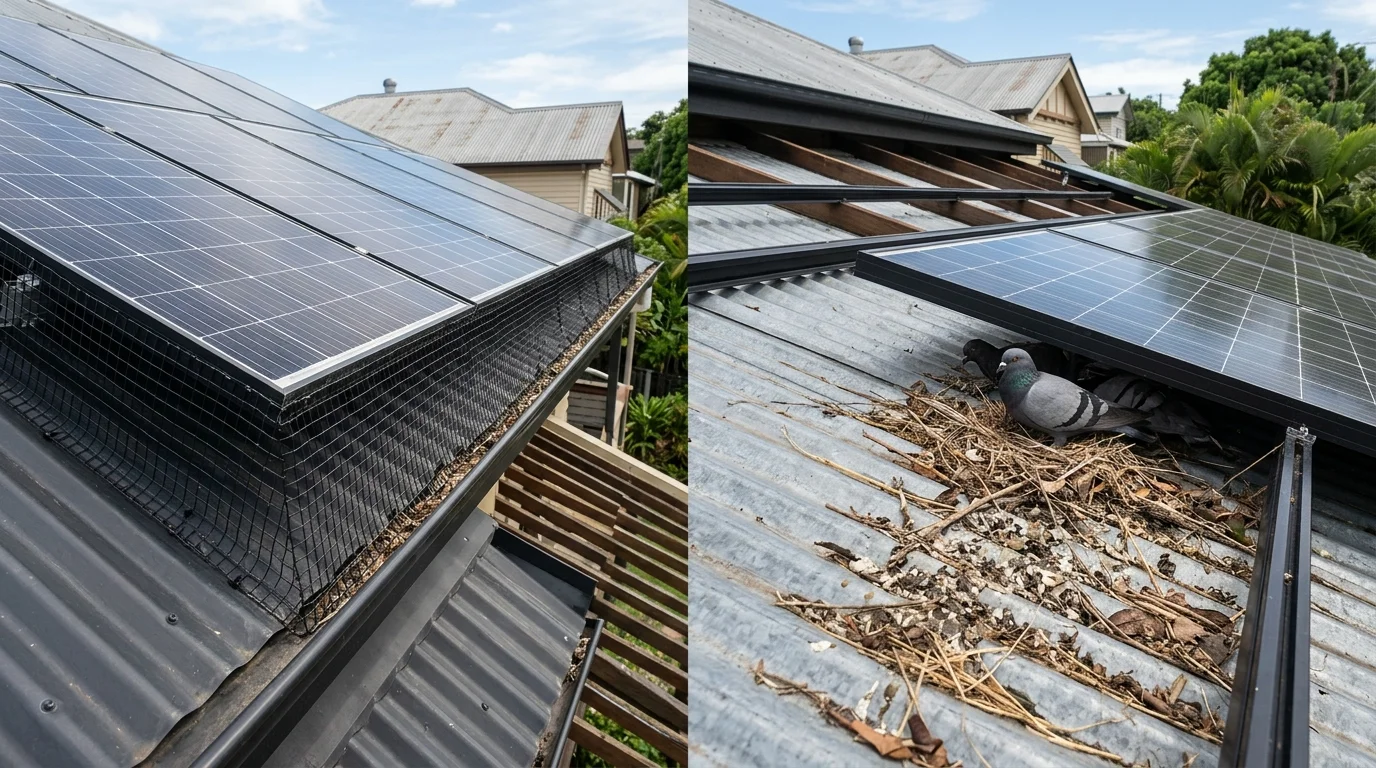
Solar panels sit raised a few centimetres above your roof surface. That gap is exactly what pigeons are looking for: sheltered, elevated, and warm. Once a pair establishes a nest under your array, others follow. The droppings accumulate on the panels themselves and also collect in gutters, on ridge caps, and across the surrounding roof sheeting.
The panels suffer in two ways. First, the droppings cast a hard shadow over cells, which reduces output more than ordinary dust does because the shade effect is concentrated. Second, dried droppings are mildly acidic. Left on glass long enough, they can etch or discolour the surface, though this typically takes many months rather than weeks.
In the Inner West suburbs, particularly in streets with large fig trees, jacarandas, and Moreton Bay figs, birds congregate in higher numbers than they do in more open suburbs further out. If your neighbours have already dealt with a pigeon problem, yours is more likely too.
What Annual Cleaning Actually Does (and Does Not Do)
A standard clean using a soft brush and deionised (mineral-free) water removes dust, pollen, and light bird droppings. In Brisbane's climate, panels typically pick up a meaningful layer of grime within six to twelve months, a mix of red dust from the west, jacaranda and poinciana pollen in spring, and general atmospheric particulates.
A professional clean restores output close to manufacturer specs and, just as usefully, gives someone a close-up look at your system. Loose cabling, cracked frames, or failed junction box seals are the sorts of things that only become obvious when a person is actually up there.
What cleaning cannot do is stop the problem recurring. If pigeons are nesting under your array, the technician will clean what is accessible but cannot reach the underside of the panels or clear the nest cavity safely without specialist equipment. You might get a clean result on day one, but within a fortnight the birds are back and the droppings have returned.
Cleaning makes sense as a standalone service when:
- You have no nesting activity, just general soiling from dust and pollen
- Your panels are less than twelve months from their last clean
- You want a baseline health check on the system
What Bird Mesh Installation Actually Does (and Does Not Do)
Bird mesh (sometimes called pigeon proofing or solar exclusion mesh) is a steel or aluminium mesh fixed around the perimeter of your panel array with clips that attach to the panel frames without drilling into them. It closes off the gap underneath so birds cannot enter to nest.
A well-installed mesh is essentially permanent. Quality products typically carry a warranty of ten or more years, and because the fixings are non-invasive, they do not void most solar panel warranties.
What mesh does not do is clean your panels. If you install mesh over a dirty array, or over an array that already has an active nest underneath, you have sealed the problem in rather than solved it. This is why reputable installers will either require a clean first or do it as part of the job.
Mesh makes sense when:
- You have seen pigeons on or under your panels, or heard scratching and cooing from your roof
- You are finding clusters of droppings rather than scattered ones
- You had a nest removed previously and want to prevent re-entry
- Neighbours on your street have had pigeon problems
The Cost Comparison
Rough ballpark figures for Brisbane residential jobs: a standard clean typically runs $250 to $400 depending on system size and roof pitch. A heavy-build-up clean for a system that has not been touched in over a year can sit closer to $400 to $600. Bird mesh installation for a typical 6 to 10-panel residential array generally falls in a similar range, though it varies by array size and roof access.
So the short version is: a single mesh installation often costs about the same as one or two professional cleans. If you are dealing with an active bird problem, repeated cleaning without mesh is the more expensive path over a two or three year window. You pay each time and the problem does not go away.
If you have no bird issue, paying for mesh is an unnecessary cost. On Queenslander-style homes common in Bardon and Paddington, the elevated roof and older fascia design can sometimes make mesh installation more involved, so it is worth getting a specific quote rather than assuming a flat rate.
The Case for Combining Both
The situation where both services genuinely make sense at the same time is this: an established nest is underneath the panels, droppings have built up on the glass, and the system has not been looked at in over a year.
In that scenario, the sensible sequence is a heavy clean first to get the panels back to a good state and allow a proper inspection, then mesh installation to close off access. Some providers will do both in one visit, which saves a call-out fee.
An annual or twice-yearly maintenance plan fits neatly on top of this. Once the bird problem is resolved and the panels are clean, a scheduled service every six months keeps output high and gives you early warning on any hardware issues before they become expensive.
For homeowners in suburbs like The Gap and Ashgrove, where tree canopy is dense and bird activity is high year-round, this combination is arguably the sensible default rather than the premium option.
Making the Right Call for Your Situation
Ask yourself two questions.
First, have you seen birds sitting on or around your panels, or noticed clusters of droppings rather than general dust? If yes, mesh deserves serious consideration, not just a clean.
Second, when did your panels last have a professional clean? If the answer is more than twelve months ago, or "never", a clean is overdue regardless of what you decide about mesh.
If the answer to both is no, a straightforward annual clean is probably all your system needs. Brisbane's subtropical climate means panels do get dirty faster than they would in Melbourne or Adelaide, but a once-a-year professional clean is manageable and cost-effective for most households.
The main thing to avoid is doing nothing. Dirty panels lose output quietly and gradually, and bird damage compounds over time. Neither problem announces itself loudly until it is already costing you money.
If you are in Auchenflower, Toowong, Milton, Rosalie, or anywhere else in the Inner West and you are not sure which service fits your situation, a quick conversation with a local provider who can look at your roof is more useful than guessing. That initial assessment is usually free or low-cost, and it gives you a straight answer rather than a general recommendation.
Quick answers