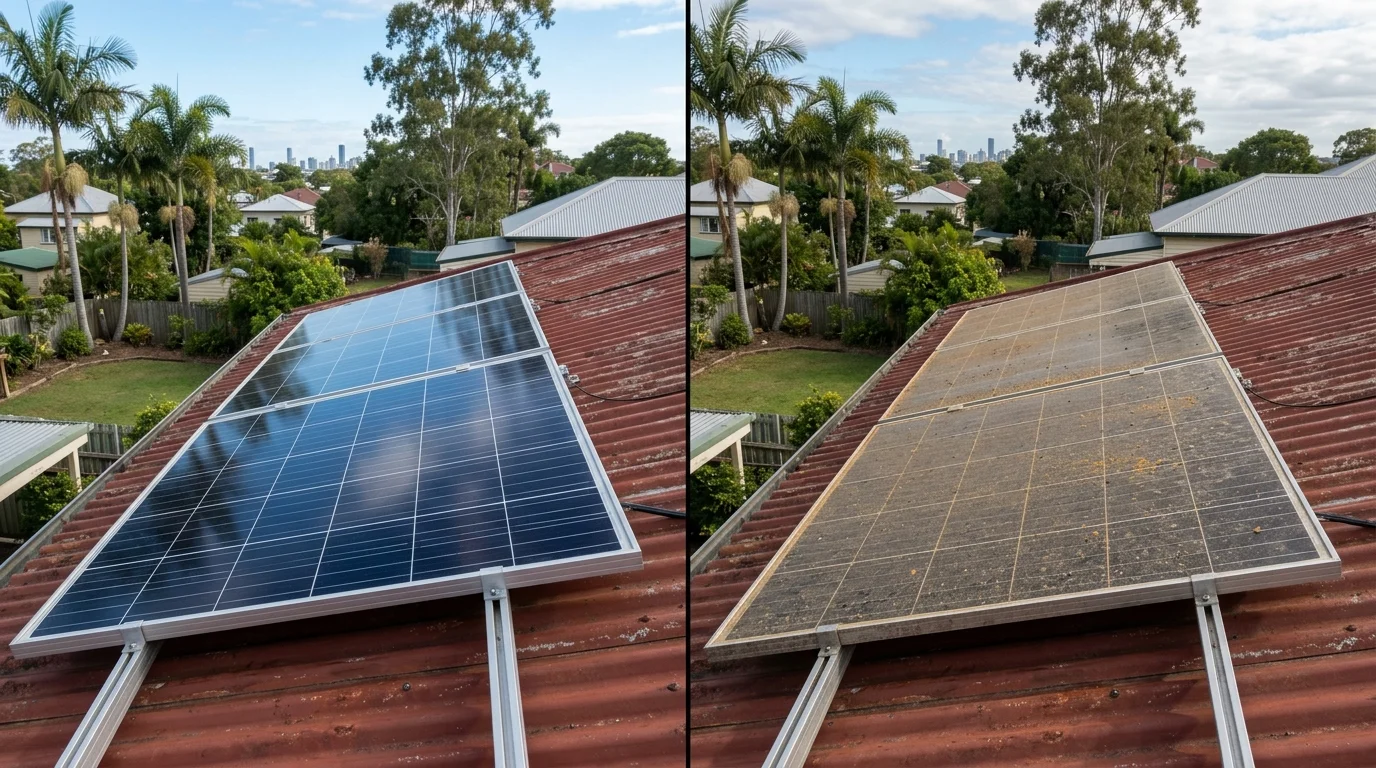
Solar Panel Cleaning guide
How often should you clean solar panels in Brisbane?
Most Brisbane homeowners get the best results from cleaning their solar panels twice a year. If your system sits under heavy tree cover, or you have a significant bird problem, three times a year is more realistic.
That said, the right answer depends on your roof, your suburb, and what's actually landing on your panels. Here's how to work it out for your situation.
Why Brisbane's climate makes cleaning more important than you might think
Brisbane has a reputation for sunshine, and that's exactly why dirt on your panels matters more here than in, say, Melbourne. More sun hours means more potential output, and more output lost when a layer of grime blocks the light.
The main culprits in this part of the city are:
- Bird droppings. A single dropping shading even a small part of a panel can cause what's called "hotspotting", where one cell works harder than the others. Over time that stresses the panel.
- Jacaranda and other pollen. Suburbs like Toowong, Bardon, and Paddington are lined with mature trees. In spring, that pollen settles on everything, including your panels. It doesn't wash off easily in a light shower.
- Dust and fine debris. Brisbane's subtropical storms deliver brief, heavy rain rather than long steady drizzle. That kind of rain often deposits a thin muddy film rather than washing panels clean.
- Construction dust. Inner West Brisbane has seen sustained residential development. If there's been work happening nearby in the last few years, your panels may have collected fine concrete or plaster dust.
The honest truth is that rain does clean panels a little. But it rarely does a thorough job, particularly if you have a low-pitch roof or panels that sit nearly flat. Water pools and dries, leaving a residue behind each time.
How much does dirt actually reduce your output?
Studies from Australian research bodies including the Clean Energy Council and CSIRO have consistently shown that soiled panels in Australian conditions can lose somewhere between 5% and 25% of their rated output, depending on the level of fouling. The lower end applies to light, even dust. The upper end is for panels with localised heavy soiling, like a row of bird droppings running across cells.
For a typical 6.6 kW system in Brisbane, that's a meaningful number. If your system is producing around 28-30 kWh on a good day and you're losing 15% to dirt, you're leaving roughly 4-5 kWh on the table daily. At a feed-in tariff of around $0.05-$0.08 per kWh (typical in Queensland right now), the dollar figure alone won't necessarily justify frequent professional cleans. But if you're a heavy daytime energy user self-consuming most of your generation, the value of that lost production is closer to your retail rate, which changes the calculation.
As a rough rule of thumb: if your monitoring app shows output noticeably lower than the same period last year and there's been no change in shading or weather patterns, dirt is worth investigating.
Twice a year, what does that actually look like?
For most homes in Auchenflower, Ashgrove, Red Hill, and the surrounding suburbs, a twice-yearly schedule works well. A logical rhythm is:
- Late summer / early autumn (February-March). By this point you've had the driest, dustiest stretch of the year. Bird activity peaks in the warmer months. A clean now restores output before the cooler months, when you may be more reliant on the grid for heating.
- Late spring (October-November). After jacaranda and other spring flowering, pollen levels drop and this is a sensible point to remove what's accumulated before the long, hot summer.
If you have a lot of mature trees on a south-facing slope (common in Bardon and The Gap), add a third clean in mid-winter. Leaf litter and moss spores are more of a factor on those shaded roofs.
DIY versus professional cleaning: a straightforward comparison
You can clean panels yourself. A soft brush on a long handle and a bucket of clean water is the minimum. Using tap water risks leaving mineral deposits as it dries, so deionised or purified water is better if you can get it. Never use a pressure washer directly on panels; it can force water into the frame and damage seals.
The honest trade-offs:
| Factor | DIY | Professional |
|---|---|---|
| Cost | Under $50 for basic tools | Typically $250-$600 per visit in Brisbane |
| Safety | Roof access is a real risk | Operator carries insurance |
| Quality | Depends on care taken | Deionised water, soft-brush method, proper technique |
| Inspection | You might miss early faults | Good operators note visible damage, wiring concerns |
| Time | 1-3 hours depending on system size | Usually under an hour |
For single-storey homes with accessible roofs and no safety concerns, DIY twice a year is a perfectly reasonable choice if you're comfortable up there. For two-storey Queenslanders (very common in Paddington and Bardon), a professional is the sensible option. Falls from residential roofs cause serious injuries every year in Queensland, and no amount of panel output is worth that risk.
One thing DIY can't replicate easily is a proper condition check. A professional visit often catches things like loose mounting brackets, micro-cracks visible on close inspection, or pigeon nesting beginning to establish under the panel frame.
The bird problem: when cleaning isn't enough
Pigeons in particular love the gap between a solar panel and a roof. It's sheltered, warm, and off the ground. Once a pair establishes a nest, others follow. The droppings from nesting birds are far heavier than passing-bird fouling and create real hygiene and corrosion issues over time.
If you're already seeing birds under your panels, or you notice heavy soiling concentrated along the bottom edge of your array, it's worth considering bird mesh installation at the same time as your next clean. Mesh sits around the perimeter of the panel array and physically prevents access. It's a one-time cost that eliminates the problem rather than managing it repeatedly.
A heavy build-up clean (for panels that haven't been touched in 12 months or more) is typically priced differently to a standard maintenance clean, because baked-on grime, lichen, and bird material require more time and care to remove safely.
A practical recommendation
If you've never had your panels professionally cleaned, start there. Get them back to a known baseline, ask the operator what they observed, and then decide on a schedule from that point.
For most homes in this part of Brisbane: twice a year, timed around late summer and late spring, is a reasonable and cost-effective habit. You don't need to overthink it.
If you want to set it and forget it, an annual maintenance plan with two cleans and an inspection locks in the schedule and the price, which makes sense if you find this sort of thing easy to put off. If you'd rather just book when you remember, that's fine too.
The main thing is not leaving it for two or three years. Grime that's been baked on through multiple Brisbane summers is harder to remove and runs a greater risk of permanent light transmission loss on the panel surface. A little regular attention is genuinely cheaper than a heavy restoration job.
If you want to connect with a local operator who cleans panels in Auchenflower and the surrounding suburbs, we can point you to someone who does this work properly. No pressure to commit.
Quick answers