Solar Panel Cleaning guide
Is it safe to clean solar panels yourself? (Brisbane roofs)
The short answer first
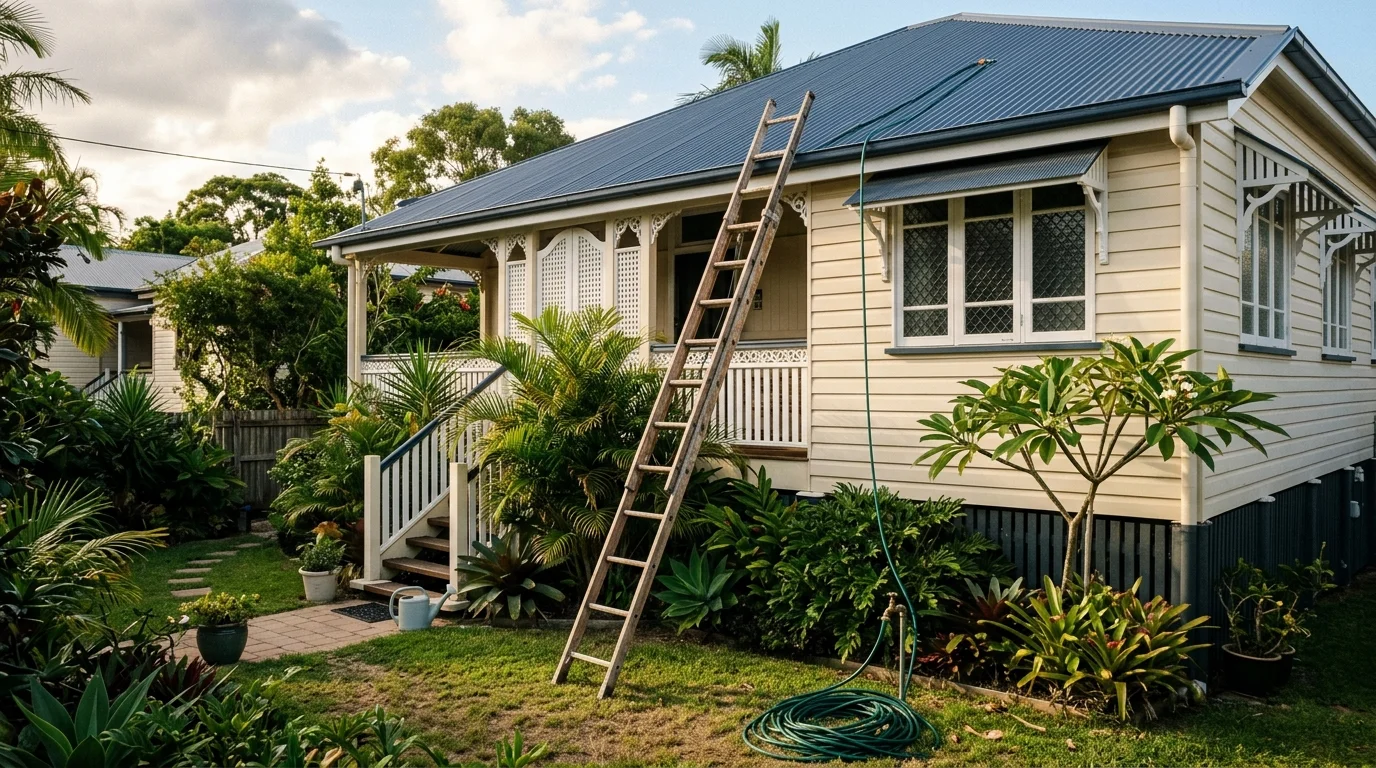
Yes, you can clean your own solar panels, but "safe" depends on two separate things: safe for you, and safe for the panels. On many Brisbane homes, especially the older Queenslanders in suburbs like Bardon, Paddington and Red Hill with steep corrugated-iron roofs, the physical risk to you is real and worth taking seriously before you fill a bucket.
What the risk actually looks like on a Brisbane roof
Solar panels typically sit on roofs pitched at 22 to 30 degrees in newer builds, and steeper still on many pre-war Queenslanders across the Inner West. That pitch, combined with a wet surface, is where the danger begins.
A few specifics worth knowing:
- Wet metal roofing is genuinely slippery. Corrugated Colorbond or old galvanised iron becomes close to frictionless when you add water and a drop of solar panel grime. If you need to step anywhere near the panels to reach them, the margin for error narrows fast.
- Most residential ladders won't give you safe working height. A standard 1.8 m or 2.4 m extension ladder gets you onto the roof, not across it. Moving laterally on a pitched roof without anchor points is where falls happen.
- Brisbane's summer storms leave panels dirtier than they look. Jacaranda pollen (particularly heavy in Ashgrove and Toowong from October through November), bat droppings, and the red clay dust that settles after inland weather events tend to form a film that only becomes obvious when you are close up. This encourages homeowners to go up and look, which is fine; the risk is staying up there too long with a hose.
Safe Work Australia consistently lists falls from height as one of the leading causes of serious injury for non-trade workers doing home maintenance. That is not meant to scare you off. It is just the honest context.
What you can safely do from the ground
If your array is accessible from a single-storey section of the roof, or if the panels are mounted at a low pitch on a flat or near-flat surface, ground-level cleaning with an extension pole is a genuinely reasonable option.
Here is what works:
- A soft-bristle brush on a 5 to 7 m telescoping pole, used with clean water (ideally deionised or filtered, since Brisbane tap water leaves mineral spotting on glass).
- A gentle rinse first to loosen dust, then light scrubbing, then a final rinse from the bottom of the panel upward to avoid streaking.
- Early morning cleaning, before the panels heat up, reduces the chance of thermal shock from cold water hitting hot glass.
What does not work well:
- Pressure washers. The seals around panel frames and junction boxes are not designed for high-pressure water. In most Brisbane installations, the manufacturer warranty specifically excludes damage caused by pressure washing.
- Dish soap or household detergents. These leave a residue that actually attracts more grime.
- Abrasive sponges or scourers. Panel glass has an anti-reflective coating that scratches more easily than standard glass.
If you can do all of that without stepping on the roof, DIY is a fair call, particularly for a twice-yearly maintenance clean.
When the build-up is heavier than a rinse will fix
Panels that have gone 12 months or more without a clean, or that have sat under a fruiting fig tree (common in Toowong and Auchenflower gardens), often have baked-on organic matter that does not shift with water alone. The same applies to persistent bird droppings, which are mildly acidic and can etch into anti-reflective coatings if left long enough.
At this point, the trade-off changes. You can scrub harder, but that risks scratching the glass. You can try a weak white-vinegar solution, which some installers cautiously recommend for spot treatment, but it is not universally endorsed and could void some warranties if used broadly. Or you accept that this is a job where the cost of professional help (typically $250 to $400 for a standard residential array in the Inner West) is buying you the right equipment and the right technique, not just the labour.
It is also worth knowing that heavily soiled panels can lose 15 to 25 per cent of their rated output, according to figures commonly cited by panel manufacturers. On a 6.6 kW system, that is a meaningful drop in export earnings or self-consumption. Whether a professional clean pays for itself depends on your tariff, your usage, and how dirty the panels actually are. There is no single right answer.
The insurance and warranty angle (worth a quick check)
Before you go up, check two things.
First, your home and contents insurance. Some policies exclude personal injury or property damage that occurs during roof work done without appropriate safety equipment. This is not a reason to panic, but it is worth a five-minute read of your product disclosure statement.
Second, your panel warranty documentation. Most tier-one panel manufacturers (LG, SunPower, REC, Jinko, and others common in Brisbane installs) require that cleaning is done with non-abrasive tools and clean water. A few specify that the use of improper cleaning agents voids the product warranty. If you are unsure, the manufacturer's website typically lists approved cleaning methods.
What a professional clean actually involves
For context, a standard professional solar panel clean in the Inner West involves soft brushes, a deionised or purified water system (which leaves no mineral residue), and typically a visual inspection of the panel frames and mounting hardware while the technician is up there.
The purified water aspect matters more than it sounds. Brisbane's tap water hardness varies by catchment, but it is hard enough to leave white spotting on glass after it evaporates. Deionised water dries clear, which means the clean result actually lasts.
A professional is also in a position to notice things a homeowner might miss: micro-cracks visible from close inspection, mounting bolts that have worked loose over time, or evidence of pigeons nesting under the array (common in Paddington and Ashgrove, where older roof profiles leave larger gaps). Pigeon nesting is worth catching early. The organic material they leave behind can trap moisture and cause frame corrosion, and the cabling damage they do can be expensive.
A practical recommendation
If you have single-storey access, low-pitched panels, and a decent extension pole, a ground-level clean twice a year is a reasonable and cost-effective choice. Take it seriously: use filtered or deionised water if you can, use a soft brush, and avoid cleaning in the middle of the day when panels are hot.
If your roof is steep, two-storey, or requires you to move across the surface with a hose, the honest advice is to leave it to someone with the right equipment and appropriate height-safety training. The cleaning cost is modest. The alternative is not.
If your panels have not been cleaned in over a year, or you have had a lot of bird activity, it is worth getting a professional in at least once to assess the actual condition before deciding whether to maintain them yourself going forward.
None of this requires a hard decision right now. But it is worth knowing where you stand before the next patch of October pollen settles in.
Solar Panel Cleaning Auchenflower connects homeowners across Auchenflower, Toowong, Paddington, Bardon, Milton, Rosalie, Red Hill, Ashgrove and The Gap with vetted local providers. Operator: Wonderfiire ABN 72 918 637 629.
Quick answers