Solar Panel Cleaning guide
The Inner West jacaranda and pollen problem for solar panels
Yes, Jacaranda Season Really Does Hit Your Solar Output
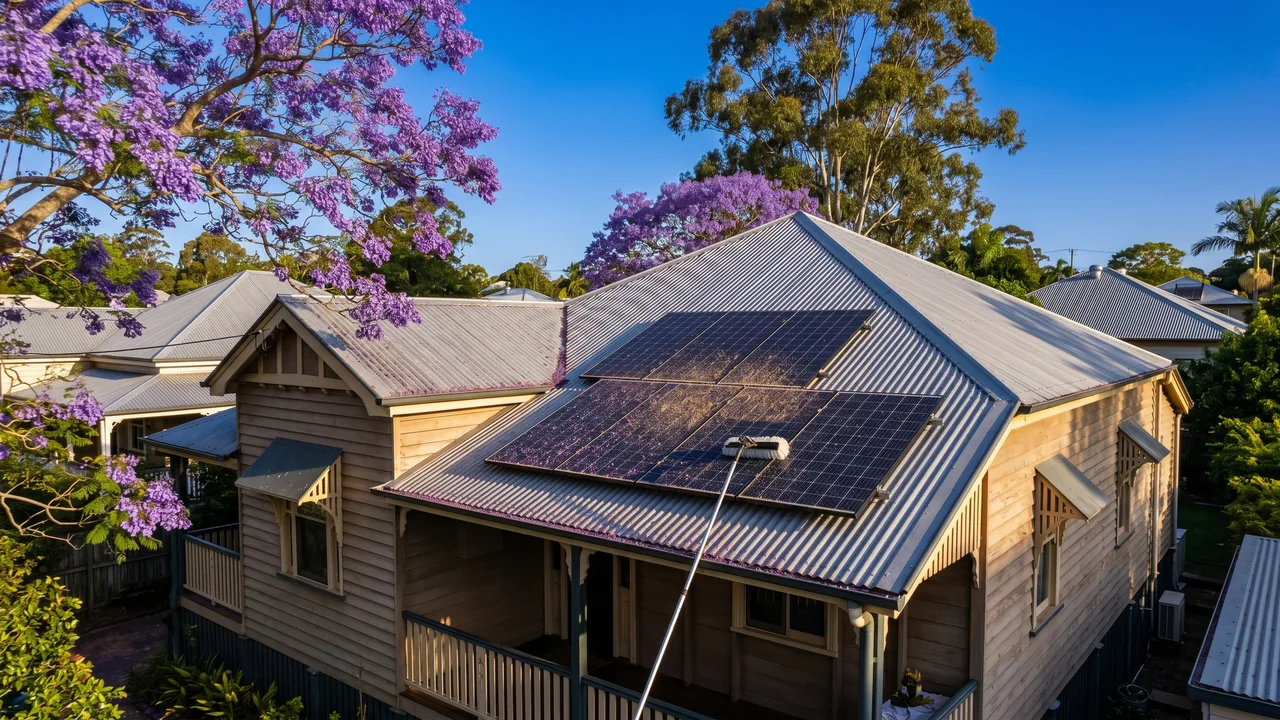
If you live in Auchenflower, Paddington, Bardon or anywhere else in Brisbane's Inner West, you already know what late October through November looks like. Purple flowers everywhere. Footpaths stained, gutters blocked, and a sticky purple film on anything left outside. Your solar panels are not exempt. The combination of jacaranda flowers, general spring pollen, and the dusty westerlies that arrive around the same time creates one of the more significant soiling events of the year for rooftop photovoltaic (PV) systems in this part of Brisbane.
This article explains what that soiling actually does to your output, why the Inner West has it worse than many other parts of the city, and how to think about cleaning: when, how often, and whether it's worth it.
Why the Inner West Gets Hit Harder Than Other Brisbane Suburbs
It comes down to tree canopy density. Suburbs like Bardon, Ashgrove, Red Hill, and Paddington have some of the oldest and tallest residential tree cover in Brisbane. Jacaranda mimosifolia was planted widely across these streets from the early to mid twentieth century, and many of those trees are now 15 to 20 metres tall. That height matters because it puts the flower drop roughly level with, or above, many rooflines.
When the flowers fall, they don't just land on the ground. They land on your roof, slide down toward the panel frames, and pile up in the gap between the panel edge and the roof surface. The sticky fluid inside the flowers then bakes in the November sun. Combine that with the fine particulate pollen that fills the air in spring (not just from jacarandas but from grass, pine, and native species flowering at the same time), and you get a multi-layer soiling event: a dry pollen film on top, and a sticky floral residue below and around the edges.
Toowong and Auchenflower also sit in a topographic pocket that can trap still air on calm mornings, which means pollen doesn't disperse as freely as it might in more exposed suburbs. The Gap, by contrast, gets more consistent wind, which helps, though it also brings more dust.
What Pollen and Flower Residue Actually Do to Output
Solar panels lose output when light can't reach the PV cells cleanly. Even a semi-transparent film of pollen reduces transmission. Research from various solar monitoring studies (typically conducted in drier, dustier climates like Western Australia and Spain) suggests that unmanaged soiling can reduce output by 5 to 25 percent depending on panel tilt, local conditions, and how long since the last clean. Brisbane's wetter climate means rain helps more than it would in Perth, but spring in the Inner West often runs dry for weeks at a stretch, right through the worst of jacaranda season.
There's also a less obvious issue: shading caused by physical debris. A cluster of decomposing jacaranda flowers sitting in the corner of a panel frame can cause localised shading. Because of the way PV panels handle partial shading (through internal bypass diodes), even a small shaded patch can drag down the output of an entire cell string, not just the shaded cells. The result is a drop in production that's disproportionate to the size of the blockage.
Pollen alone, without visible debris, still costs you something. It's fine enough that you might not notice it from the ground, but close up it creates a matte coating over the glass that standard rainfall won't fully remove.
The "Rain Cleans My Panels" Assumption
It's partly true. Brisbane's summer storms, and even moderate spring rain, do wash off light surface dust reasonably well. But rain has limitations that matter more in the Inner West than in, say, a newer outer suburb with clean concrete tiles and no overhanging trees.
First, rainwater carries dissolved minerals. When it evaporates, it leaves those minerals on the glass surface. Over time, this creates a faint but cumulative scale that actually makes future soiling stick more readily.
Second, rain doesn't dissolve the sticky residue from jacaranda flowers. That material is partly organic and partly resinous. It needs mechanical action, not just water, to shift properly. Rain will move loose petals, but it won't clean the stain they leave behind.
Third, panels on older Queenslander-style roofs (common through Paddington, Bardon, and Red Hill) often sit at lower pitches than modern installations, or are installed on skillion additions. Lower-pitch panels drain more slowly and tend to accumulate more residue in the bottom edge of the frame.
DIY Cleaning: What Works and What Can Go Wrong
Some homeowners do clean their own panels, and for a single-storey home with safe roof access, it's not unreasonable to consider. If you go that route, a few things matter.
Use deionised or demineralised water. Tap water leaves mineral deposits. A squeegee or a soft-bristle brush designed for the purpose is fine; anything abrasive (scouring pads, stiff brushes) will scratch the anti-reflective coating on the glass and cause long-term damage.
Don't use detergent unless you know it's panel-safe. Some surfactants leave a film or can void panel warranties.
The realistic constraints: most Inner West homes are double-storey, or are Queenslanders elevated on stumps, which puts even a single-storey roof at a height that makes ladder work genuinely risky. If you can't stand on the roof safely and reach the panels without awkward stretching, the job isn't worth the risk. A professional clean in this area typically costs $250 to $400 for a standard residential system, which is a reasonable trade-off against the injury risk and the time.
Heavy build-up, meaning panels that haven't been cleaned in 12 or more months, often needs more than a standard wipe. Baked-on pollen residue and flower staining can require a longer dwell time with the right water and careful agitation. That's generally a job for someone with the right equipment.
How Often Should You Clean, and When?
For most Inner West homes under a jacaranda tree or near significant tree canopy, twice a year is a defensible routine. The timing that makes sense locally:
- Post-jacaranda (late November to December): After flowering has finished and before the summer storms arrive. This clears the worst of the spring soiling before panels go into the high-generation summer months.
- Late dry season (August to September): After the dry winter and before spring pollen begins. Clears the winter dust accumulation and gives you clean panels heading into the spring flush.
If your system is monitored (most inverters built after roughly 2015 give you app-based output data), watch the numbers in October and November. A visible dip relative to similar sunny days in September can help you judge whether cleaning is actually needed, rather than going purely on calendar schedule.
Homes without overhanging trees, or with panels on north-facing roofs at a steeper pitch (more common in newer builds in The Gap and Ashgrove), may genuinely get away with once a year, particularly if summer storms are doing reasonable work.
A Sensible Way to Think About the Cost
A twice-yearly professional clean on a typical 6.6 kilowatt system in this area costs roughly $500 to $600 per year if you're on an annual plan. Whether that pays for itself depends on your feed-in tariff, your self-consumption rate, and how dirty your panels actually get.
Running rough numbers: a 6.6 kW system on a clear Inner West day should produce around 25 to 30 kilowatt-hours. A 15 percent soiling loss (plausible after a full jacaranda season without cleaning) represents 3.75 to 4.5 kWh per day. At a self-consumption value of around $0.30 per kWh (avoiding grid purchase), that's over a dollar a day, or roughly $30 to $40 across a month of peak soiling. Across two months, you're approaching the cost of a single clean before the numbers get speculative.
The honest answer is that the financial case is marginal for many households, and it depends heavily on your specific situation. The clearer case is for households where the system is larger, the soiling is visible, or the panels are simply not draining well due to roof geometry.
What's unambiguous: cleaning before selling your home, or before an inspection, is always worthwhile. Panel condition affects valuation and buyer confidence, particularly as solar becomes a standard feature buyers notice.
A Closing Thought
If you're in Paddington, Bardon, Auchenflower, or the surrounding Inner West suburbs and you've never had your panels cleaned since installation, a post-jacaranda clean in November or December is a reasonable starting point. Look at your inverter data in October as a baseline, clean in December, and compare. That gives you real information rather than guesswork.
You don't need a hard sell on this. Either your output data shows a problem, or it doesn't. Either your panels have visible residue from the season, or they're managing fine. The goal is to make an informed decision with your own system's numbers in front of you, not to clean out of anxiety.
If you'd like a local provider to take a look and give you an honest assessment before committing to anything, that's a straightforward conversation to have.
Quick answers