Solar Panel Cleaning guide
Soft brush vs pressure washing solar panels: what is safe?
Soft Brush vs Pressure Washing Solar Panels, What Is Safe?
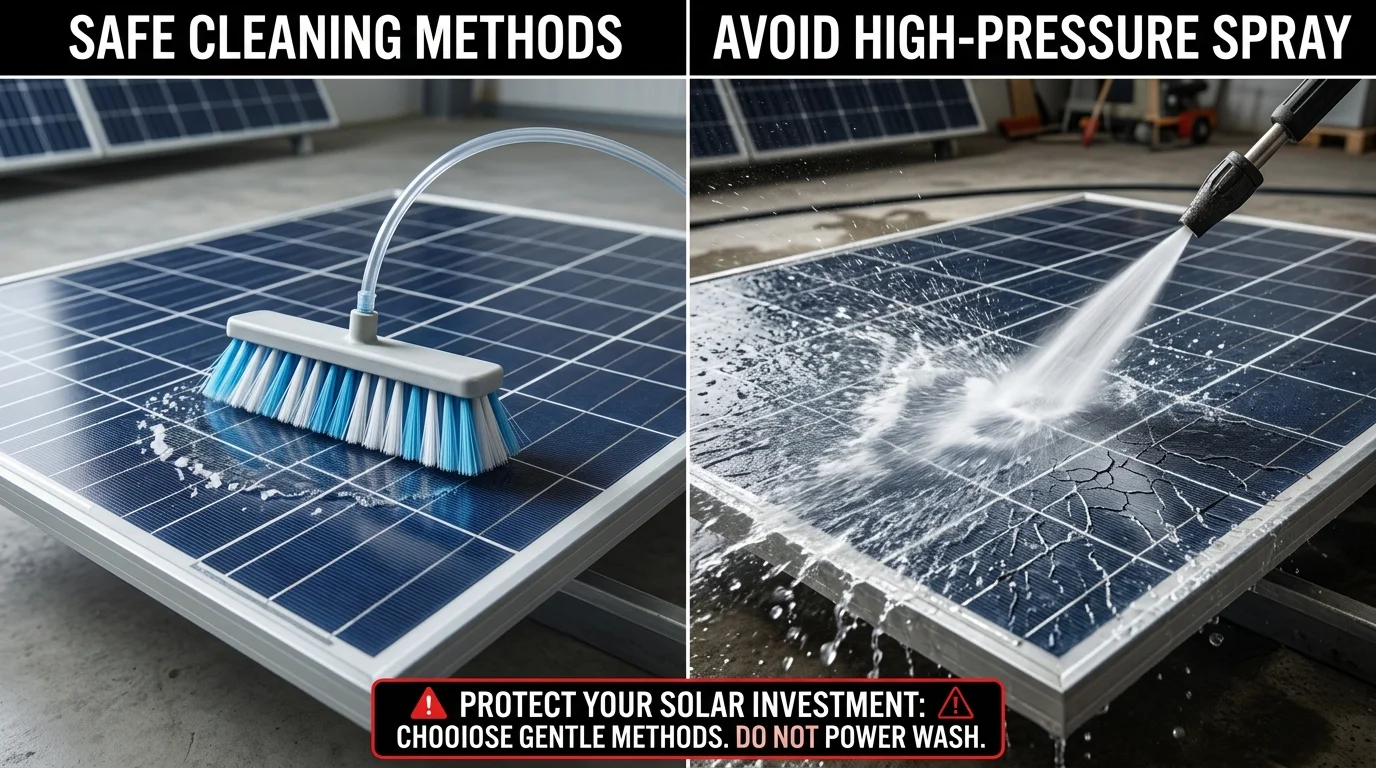
The short answer: a soft brush with deionised water is safe. A pressure washer usually is not. That said, the full picture is worth understanding, because there are genuine reasons people reach for the pressure washer, and a few edge cases where some water pressure is appropriate.
Why the Cleaning Method Actually Matters
Solar panels look tough. They sit on your roof through Brisbane summers, hailstorms and whatever a jacaranda tree decides to drop on them. But the glass surface is more sensitive than it appears.
Most residential photovoltaic (PV) panels have an anti-reflective coating on the glass. This coating is what helps your panels capture more light, particularly on overcast days. It is microscopically thin, and abrasive tools or high-pressure water can degrade it over time. Once that coating is scratched or stripped, you cannot restore it without replacing the panel.
Beyond the glass, there are other components worth thinking about:
- Junction boxes and wiring connectors sit underneath the panel, partially exposed to water ingress. Most are rated to handle rain, not a focused jet from a pressure washer.
- Frame seals (the rubber or silicone gasket around the panel edge) can lift or crack under sustained high pressure, letting water into the laminate layers.
- Roof fixings and flashings around the racking system can be disturbed if you are directing water at awkward angles up on a steep pitch, which is common on older Queenslander-style homes in suburbs like Bardon and Red Hill.
None of this means your panels will explode if you hit them with a garden hose. It means there is a meaningful difference between a gentle rinse and a pressure wash, and the risk is cumulative.
What a Soft-Brush Clean Actually Involves
A proper soft-brush clean is not complicated, but the details matter.
You use a brush with soft, non-abrasive bristles, typically a brush head mounted on a water-fed pole. The water running through the pole is deionised, meaning minerals have been removed from it. Tap water in Brisbane contains dissolved calcium and magnesium. When that water dries on a panel surface, it leaves behind white mineral deposits (often called water spots or hard water marks). Deionised water evaporates cleanly.
The brush loosens dust, pollen, and bird droppings. The deionised water rinses everything away. No detergent is needed in most cases, and most panel manufacturers specifically advise against soap, which can leave a film that attracts more grime.
For Inner West Brisbane suburbs like Auchenflower, Toowong and Paddington, the main culprits are:
- Jacaranda pollen and flowers (October to December, mostly) which form a sticky film when wet
- Bird droppings from the ibis and sulphur-crested cockatoos that are common across Ashgrove and The Gap
- General traffic and construction dust from proximity to major roads including Coronation Drive and Moggill Road
- Mould and biofilm that can build up on the shaded side of panels during humid months
A soft-brush clean handles all of these without risk to the panel surface or your warranty.
The Case For (and Against) Pressure Washing
People reach for pressure washers for understandable reasons. They are fast, they feel effective, and if you already own one, the perceived cost is zero.
There is also a grain of truth here: some commercial solar installations use low-pressure automated cleaning systems with water jets. The key word is low-pressure. These systems are engineered for the task, typically operating well below the threshold that causes seal damage.
A standard domestic pressure washer is a different thing. Most operate between 1,300 and 2,000 PSI (pounds per square inch). Some of the more powerful units go higher. Panel manufacturers typically specify a maximum cleaning pressure of around 35 to 70 bar (roughly 500 to 1,000 PSI) and usually require you to maintain a safe distance. In practice, homeowners standing on or near a ladder rarely hold the nozzle at the correct angle and distance consistently across an entire array.
The real-world consequences tend to be gradual rather than catastrophic:
- Coating erosion that reduces output by a few percentage points per year
- Micro-cracks in cells, invisible from the outside but detectable as hotspots on a thermal inspection
- Frame seal failure that voids your panel warranty
- Water intrusion into the junction box causing corrosion
For panels that have been neglected for 12 or more months, baked-on grime (especially bird droppings that have hardened in Brisbane's heat) does sometimes need more than a gentle brush pass. The appropriate response is a heavier-duty soft-brush technique with a longer soak time, not a switch to high pressure.
DIY Cleaning vs Calling Someone In: An Honest Trade-Off
You can clean your own panels safely if you are methodical about it. Here is what that honestly requires:
- Access to the roof safely (steep roofs, particularly on Queenslanders, are a real hazard)
- A water-fed soft brush or a clean, non-abrasive sponge mop
- A way to source or make deionised water, or at minimum, filtered water
- Time, confidence at heights, and the physical effort of doing it properly
The main risks are not to the panels. They are to you. Falls from roofs are a significant cause of serious injury in Australia, and Inner West Brisbane properties often have steep or multi-level roof lines that make DIY access genuinely dangerous.
If your system is a standard single-storey install with safe roof access and you are comfortable up there, a careful DIY clean with the right equipment every six months is perfectly reasonable. If your panels are on a second storey, a steep pitch, or over a verandah, a professional clean is worth the $250 to $600 it typically costs in this area, partly for the result and partly because someone else is carrying the risk of working at height.
Frequency and What It Means for Your Approach
How often you clean affects which method makes sense.
Panels cleaned every three to six months rarely accumulate the kind of baked-on grime that tempts people toward pressure washing. A standard soft-brush clean takes 30 to 45 minutes for a typical 6 to 10 panel residential system and leaves the surface spotless.
Panels left for 12 months or more in a suburb with heavy tree cover (think Bardon or Ashgrove, where fig trees and Jacarandas are everywhere) can develop a biofilm layer that needs more attention. This is where a heavy build-up clean, using prolonged soak time and a firmer brush technique, is appropriate. It still does not require pressure.
Twice-yearly cleaning aligned with the end of Jacaranda season (December) and before winter dust settles (May or June) is a reasonable schedule for most Inner West Brisbane homes.
A Closing Recommendation
If you are trying to decide between methods, the evidence lands clearly on the soft-brush side. There is no meaningful cleaning task on a residential solar panel that requires a pressure washer, and the cumulative risk to coatings and seals is real even if it is not dramatic.
Whether you do it yourself or have someone do it for you depends on your roof, your comfort at heights, and how much you value your time. Both are legitimate choices. What is not worth the gamble is using a pressure washer to save 20 minutes of scrubbing, on a system that probably cost you $8,000 to $15,000 to install.
If your panels have not been cleaned in over a year, or if you are not sure what condition they are in, a professional inspection and clean is a reasonable starting point. A good operator will tell you honestly what they find, including if there is nothing urgent to worry about.
Quick answers